The First Flight to Nelson
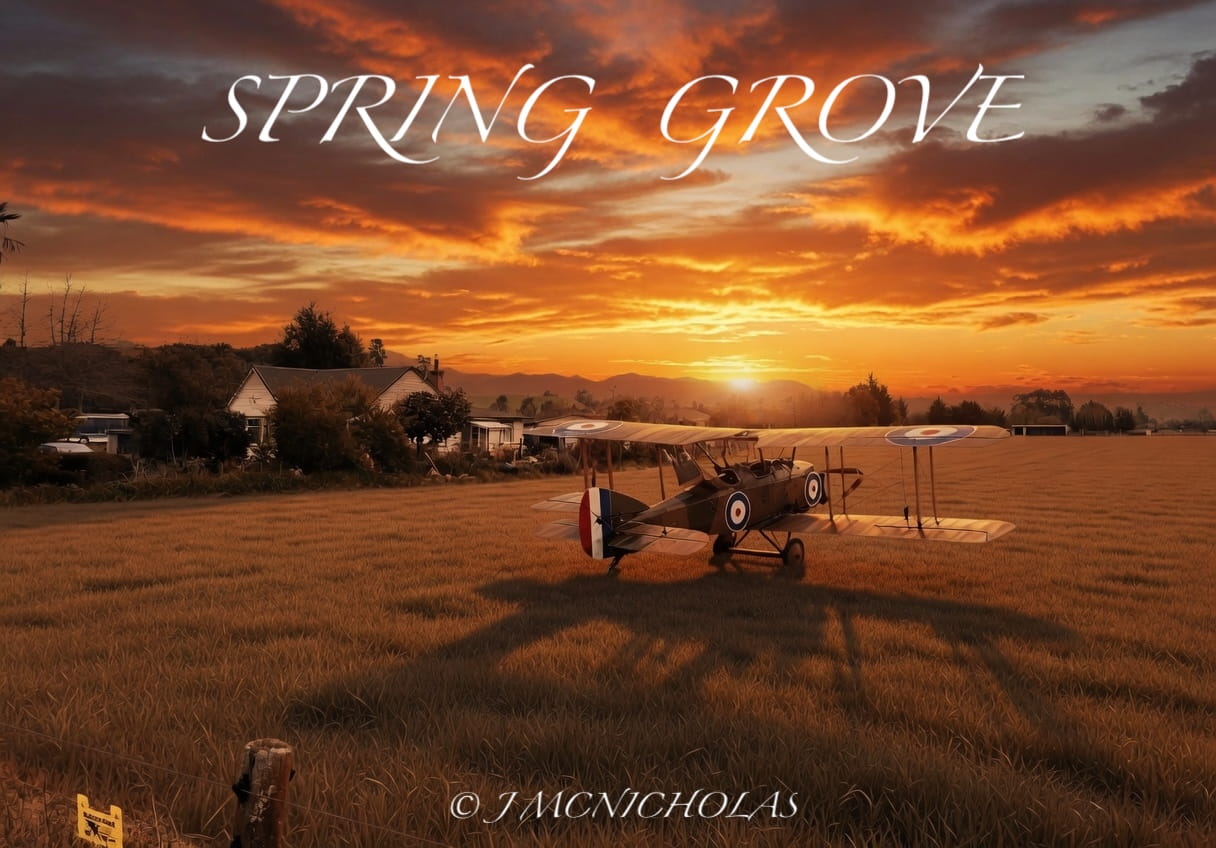
On the 11th of November 1921, a converted World War 1 Avro 504K biplane with three men onboard landed in Spring Grove after a daring crossing of the Cook Strait. The intended destination had been passenger Tom Newman’s farm paddock at Brightwater. After flying for two hours and 20 minutes they reached Nelson but with just a gallon of fuel to spare, the plane was forced to land in Stoke. After refreshments at the neighbouring hotel, the field’s elderly owner James Marsden instructed them to clear the plane from his property. refuelled and flew on towards Brightwater; however, the paddock there was too small, and the pilot eventually landed in a more suitable paddock at nearby Spring Grove.
John McNicholas was always intrigued by the story of the biplane landing on his great- grandfather William Arnold’s farm in Spring Grove that day in 1921. He has created this video of pilot Philip K ‘Shorty’ Fowler’s 1959 personal account of the flight.
The Flight
On 11 November 1921, transport pioneer Tom Newman achieved his ambition of bringing the first aeroplane to Nelson. Two previous attempts had been made from Fairhall Aerodrome in Blenheim; the first on November 5th was thwarted by bad weather over the Richmond Ranges, the second on the 6th was not only also foiled by weather but with the engine failing at 800 metres, the pilot had to make an emergency landing, resulting in a heavily bruised arm for passenger Tom.1
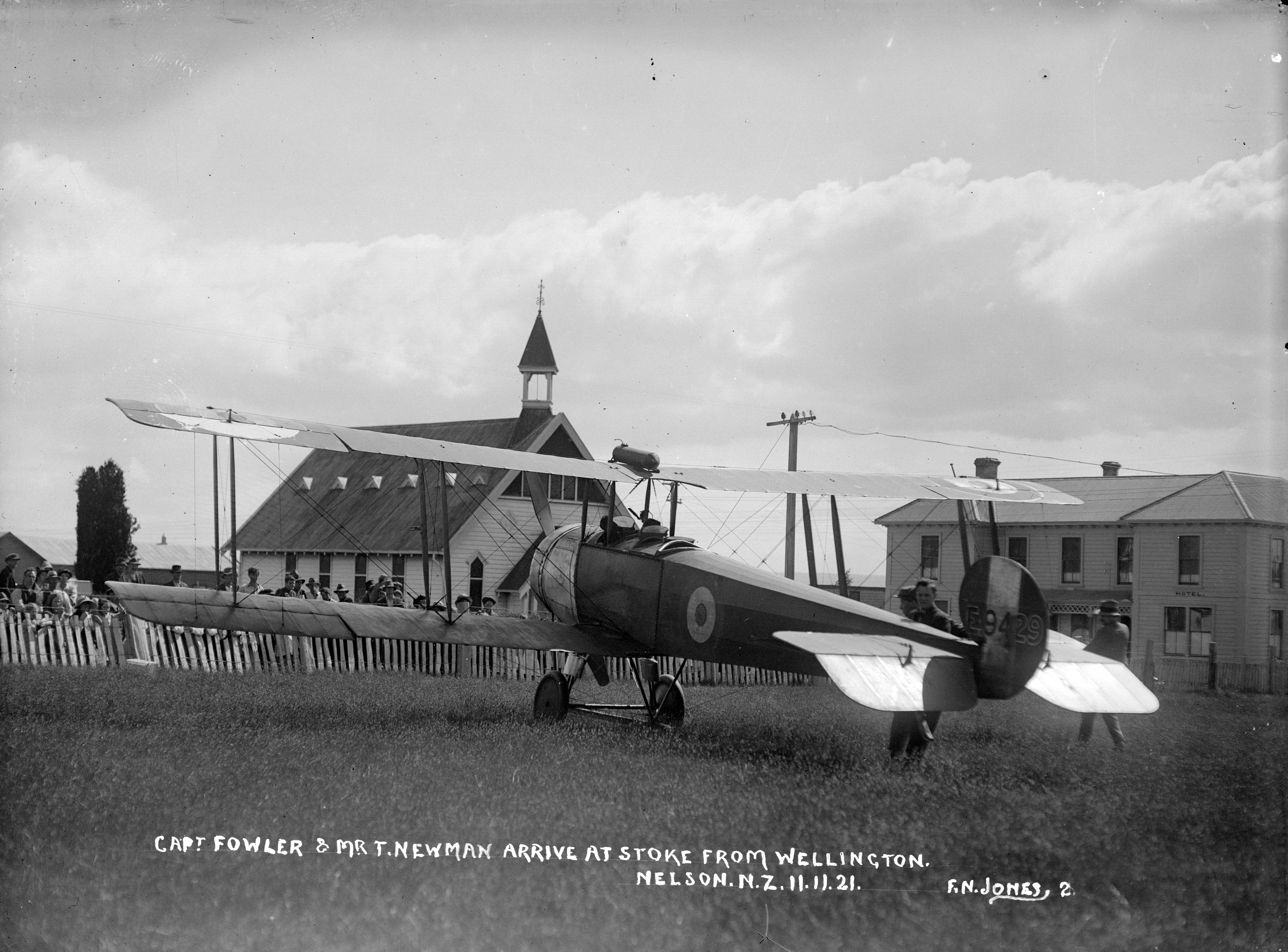
Not to be deterred from his mission, Tom then took the Ferry to Wellington where he enlisted the services of First World War pilot Captain Philip K. ‘Shorty’ Fowler in an Avro 504 K biplane, E9429, at the then considerable cost of £100. Captain Fowler was a pilot in the Royal Naval Air Service during the war and later would go on to be the commandant of the Air Training Corps in 1944.2
Joining Tom and Shorty was mechanic Ted Ranish; the three men had to wait until around 10am due to the overcast weather before taking off from a makeshift airstrip at Lyall Bay, actually a football field near the site of the present-day Rongotai College. They set off to cross Cook Strait with only a compass, a simple cross-level, and a school atlas for navigation. They could only climb to 2000 feet, “I wasn’t very happy about it, but you couldn’t get any higher” Fowler said in a 1959 Radio New Zealand interview. “Once you got into cloud in those days especially when you’re approaching a rugged coast like the north of the South Island – you just don’t do those sorts of things”.3
The pilot was equipped with a flying coat, stuffed with kapok, to keep him afloat in the event of a crash into the water. Passengers Tom and Ted had no such form of protective wear. “They didn’t seem to worry about that though” Fowler said in his interview. Reflecting on the flight later in life, Fowler said he “would not cross the straight today (in the Avro) for a gold clock or £1000” (Newman, 2021).
Despite the heavy cloud conditions and the danger, when he was interviewed by the Nelson Evening Mail afterwards, Mr Newman reported “he had a splendid trip across and thoroughly enjoyed every bit of it.” (Newman, 2021).
As they approached Nelson, they were running extremely low on fuel and Shorty started looking for somewhere to set the aircraft down. They had 20 gallons of fuel in the tank when they left Wellington, and according to Fowler the Avro went through about 9 gallons of fuel per hour, along with two gallons of oil. With the trip taking 2 hours and twenty minutes they were already going to be operating right at the limits of the Avro’s range. “When we got to French Pass, just after that I asked Mr Newman if he had any idea where we are – and he hadn’t got a clue.” (Newman, 2021).
As they flew down the bay, they were able to pick out Nelson, but as they circled over the Nelson Post Office the engine ran out of fuel. The Avro had a 4-gallon gravity fed reserve tank on the top wing which enabled them to fly on and find a suitable landing spot. Shorty had spotted the Wakapuaka mud flats, but Tom warned him against landing there.
Fowler made an emergency landing at Isel Farm, on a field adjacent to the Stoke Hotel, (part of Greenmeadows playing fields today), with only 1 gallon of fuel left in the reserve tank. The arrival caused a sensation. A sizeable group soon gathered to witness the aircraft, Richmond Mayor William Wilkes among them. He welcomed the aviators, congratulating them on becoming the first people to reach the Nelson district by air. Captain Fowler was astounded by the large crowd, “It was marvellous, I’ve never had such a reception in all my life. There was just a stream of people, the first time they’d seen an aircraft, most of them” he said. (Newman, 2021).
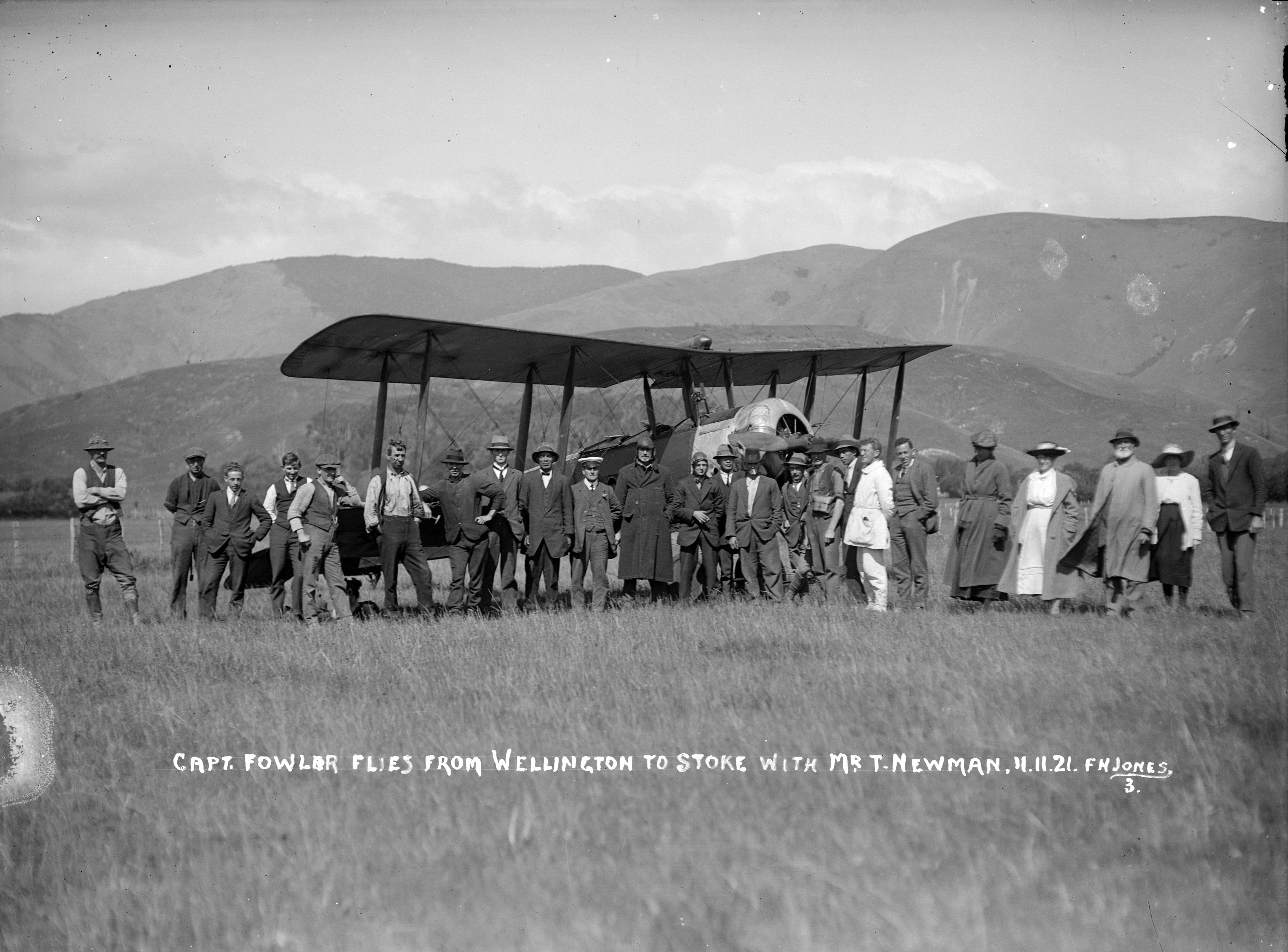
After refuelling at nearby Walter Heath’s garage, and with instructions from James Marsden’s gardener to clear off his farm4, Shorty determined that the field was too short for the aeroplane to lift off with three people onboard, therefore taking off on his own and landing on nearby Saxton’s farm to collect Ted and Tom where another crowd had gathered. The Saxton’s Field sports complex is now situated on this large field.
Shorty flew on towards Brightwater, however as they approached the intended landing place on Mr Newman’s farm Naumai, it quickly became apparent that the fields there were too small. Circling around, Shorty spotted a suitable field in nearby Spring Grove, on William Arnold’s farm. Adjacent to Telenius house, the field was situated between that building and the Spring Grove Railway, and the plane was soon landed safely mid-afternoon.
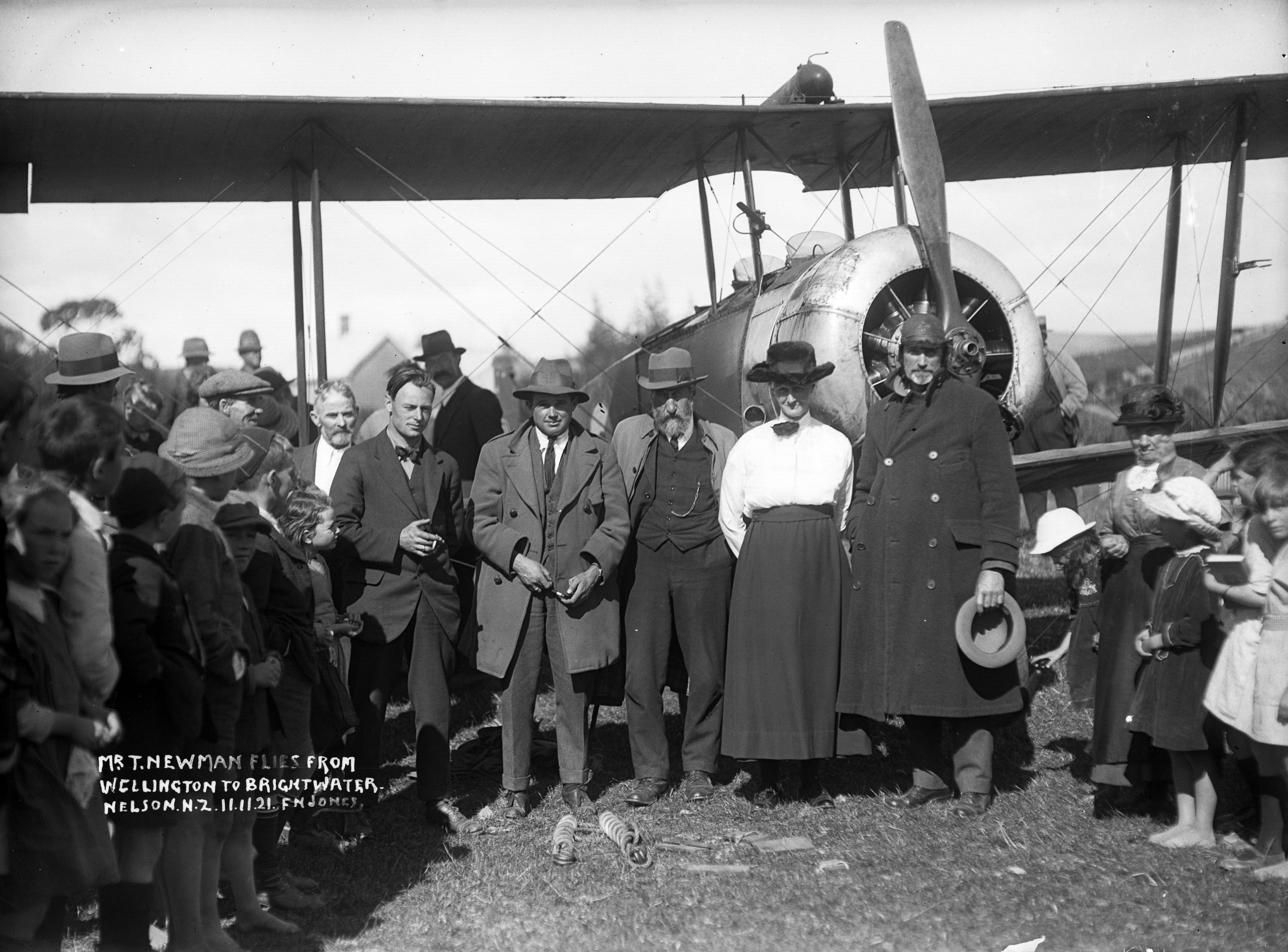
As with its landing at Stoke, the plane soon attracted a large crowd. Pictured above in William Arnold’s field, from left Willam Arnold (hatless and wearing a white shirt), Ted Ranish (mechanic), P.K. ‘Shorty’ Fowler (pilot), Alexander Thomson (Mrs Newman’s father), Christina Newman, and Tom Newman. Two spring-type aircraft tie-downs can be seen on the ground in front of Captain Fowler.
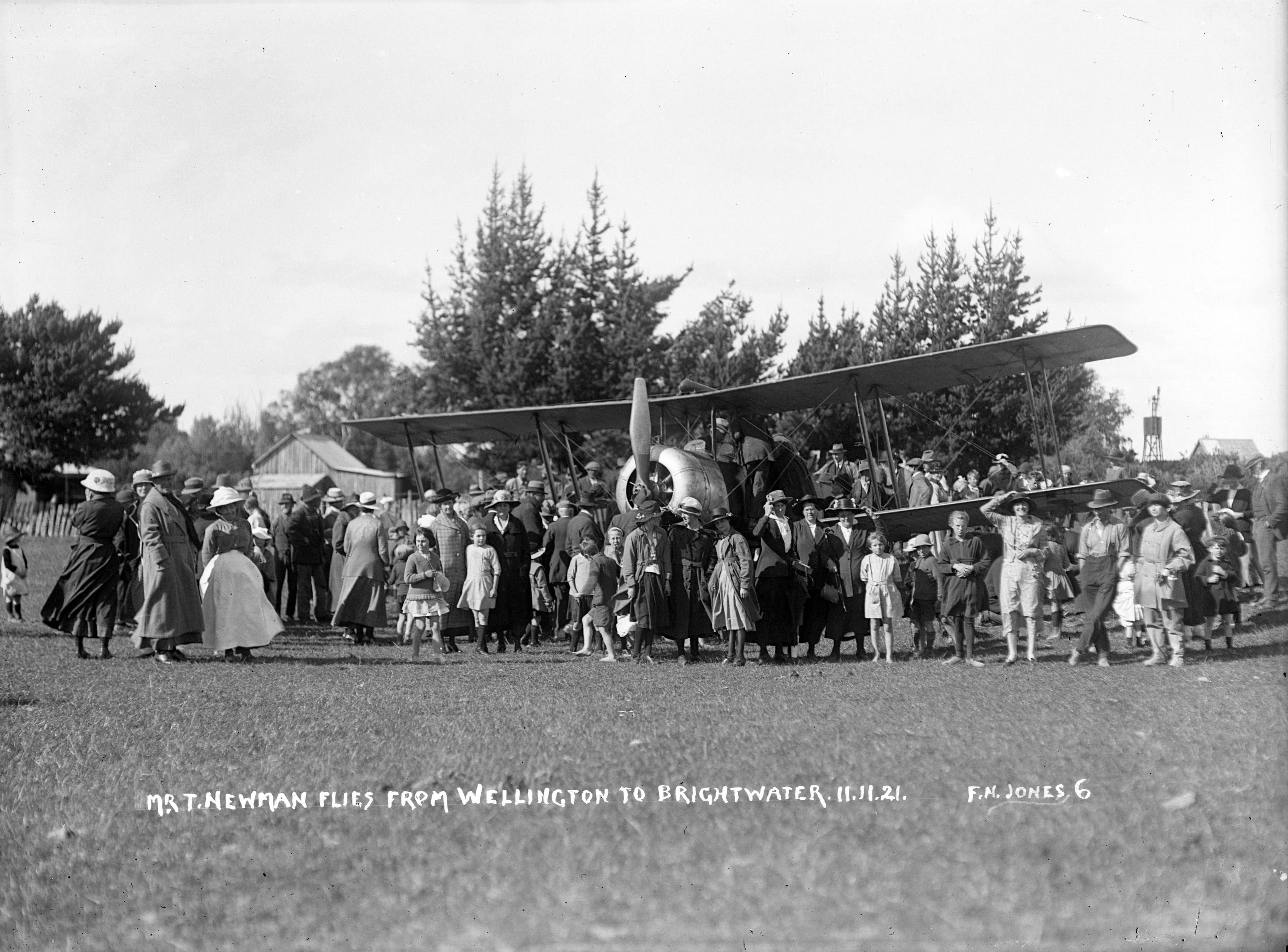
According to Aviation historian Richard Waugh, the 1921 flight had taken a certain amount of courage and determination to attempt. “You’re talking a World War 1 aircraft with World War 1 engine reliability. It was fairly primitive, and a calculated risk from the three of them to get in a plane and head out over the Cook Strait. If the engine failed, you’d be in really big trouble”.5
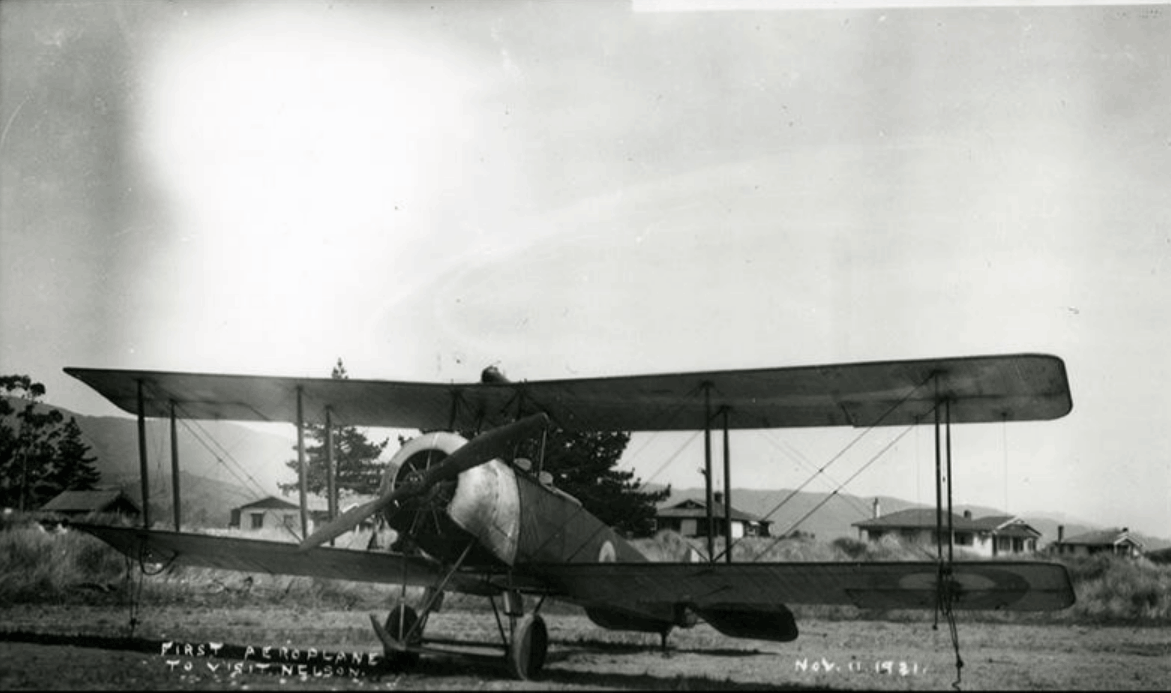
The Captain stayed in Nelson following the flight; he was joined two days later by pilot Herbert Nelson Hawker who transported two passengers from Blenheim in a CAC de Havilland DH9, landing at Saxton’s paddock. Nelson City Council permitted the pilots to give joyrides on alternate days at Tāhunanui Beach. Captain Fowler reported making up to £120 per day by taking eager Nelsonians up to see their city from the air, charging £1 per flight. “Once you get somebody to break the ice, the rest will follow like sheep through a race in those days” he said.6
Tom Newman’s eldest son Jack flew with Shorty Fowler, and an interest in aviation was ignited. Later he was influential in the forming of both the Nelson Aeroclub and Cook Strait Airways.7
Meanwhile Shorty Fowler returned to Nelson on the 17th of February 1923, when he piloted the first floatplane to come to the Region, alighting on Nelson Harbour in an Avro 504L, H2989. It was another three years before the next aircraft visited Nelson, and it wasn’t until 1935 that Cook Strait Airways scheduled flights from the Stoke airfield.8
The Site Today
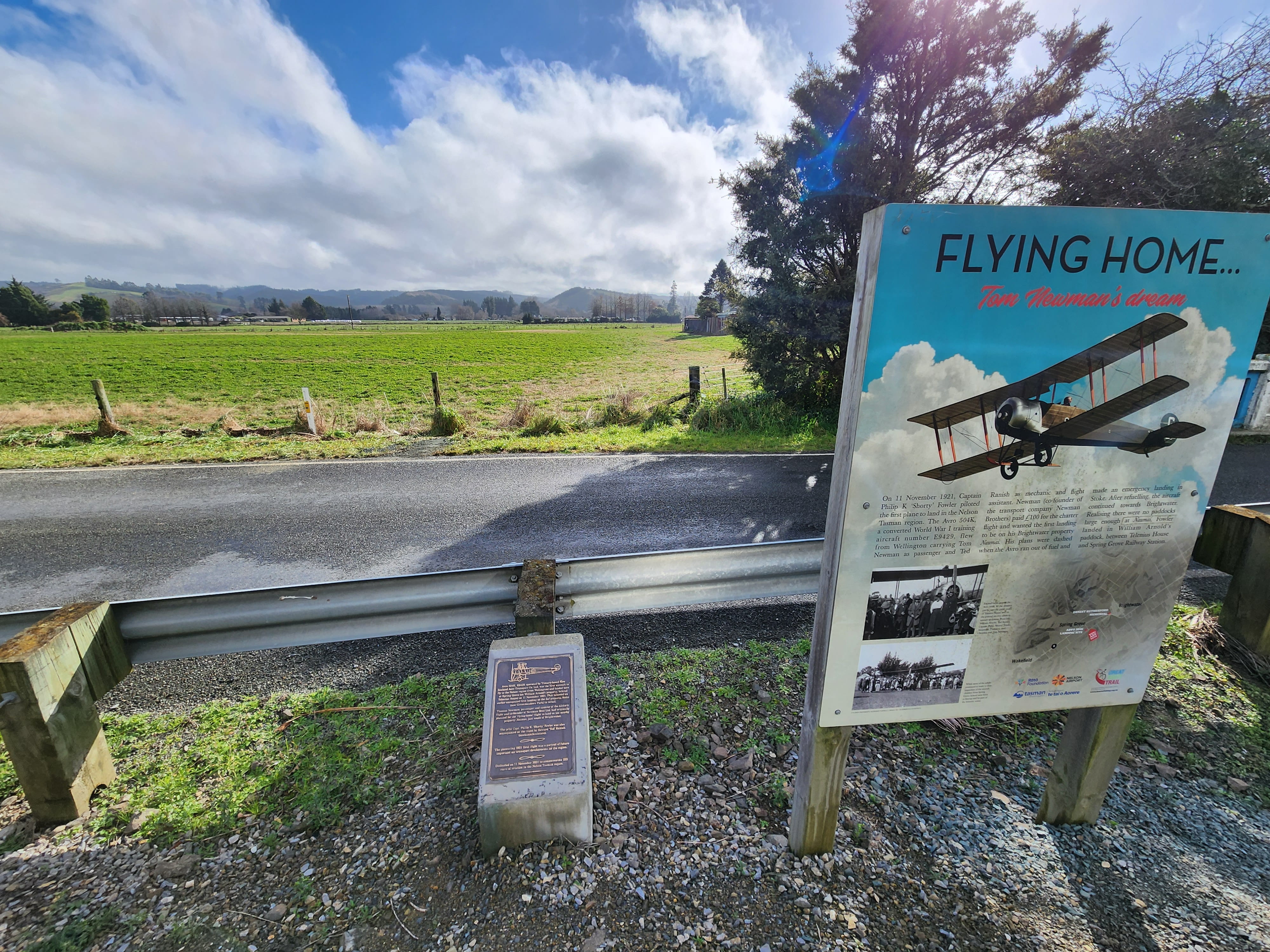
On November 11th 2021, a commemorative plaque and interpretation panel was installed at the site of the historic landing site in Spring Grove, celebrating 100 years of aviation in the Nelson Tasman region.
Where is the story located?
The First Flight to Nelson story is still under development by our team and is not available yet. In the mean time, check out our other stories!
Agumented Reality Experience
Our Augmented Reality (AR) app is currently under development. The app will allow posts to be scanned, bringing the stories into life!
References
- Top South Media. (2021, October 31). Nelson magazine - November 2021. Issuu. https://issuu.com/nelsonweekly/docs/11-21_nelson_magazine_web/23.
- Top South Media. (2021).
- Newman, T. (2021, October 30). Nelson's first flight: On a wing and not much fuel to spare. Stuff. https://www.stuff.co.nz/nelson-mail/126736166/nelsons-first-flight-on-a-wing-and-not-much-fuel-to-spare.
- Nelson Historical Society. (2014, February). Nelson's aviation history. The Prow.org.nz- Ngā kōrero o te tau ihu. https://www.theprow.org.nz/enterprise/nelsons-aviation-history/.
- Newman. (2021).
- Newman. (2021).
- Top South Media. (2021).
- Nelson Historical Society. (2014).
- Story thumbnail: John McNicholas, Captain 'Shorty' Fowler's Avro 504K Bi-plane landing at Spring Grove, 11 November 1921. Digital historical reconstruction artwork depicting the historic arrival of the region's first aircraft, which landed in the artist's great-grandfather, William Arnold's field.