Spring Grove Wesleyan Chapel (1858 – 1958)
Contents
The cob-walled Wesleyan chapel at Spring Grove stood as a centre of worship and community life for a century. It was officially opened on Sunday April 18th, 1858, with inaugural sermons preached by the Reverends Patrick Calder, Decimus Dolamore and John Warren. Alongside its regular weekly services, the chapel hosted a wide range of gatherings, including day school examinations, Circuit Quarterly meetings, anniversary tea meetings, harvest festivals, and other public events.
The chapel is also linked to one of New Zealand’s most notable figures. On the 5th of August 1873, Ernest Rutherford—later known as Lord Rutherford—was baptised here by the Reverend William Cannell. Ernest was the fourth son of James Rutherford, a wheelwright, and Martha Rutherford.1
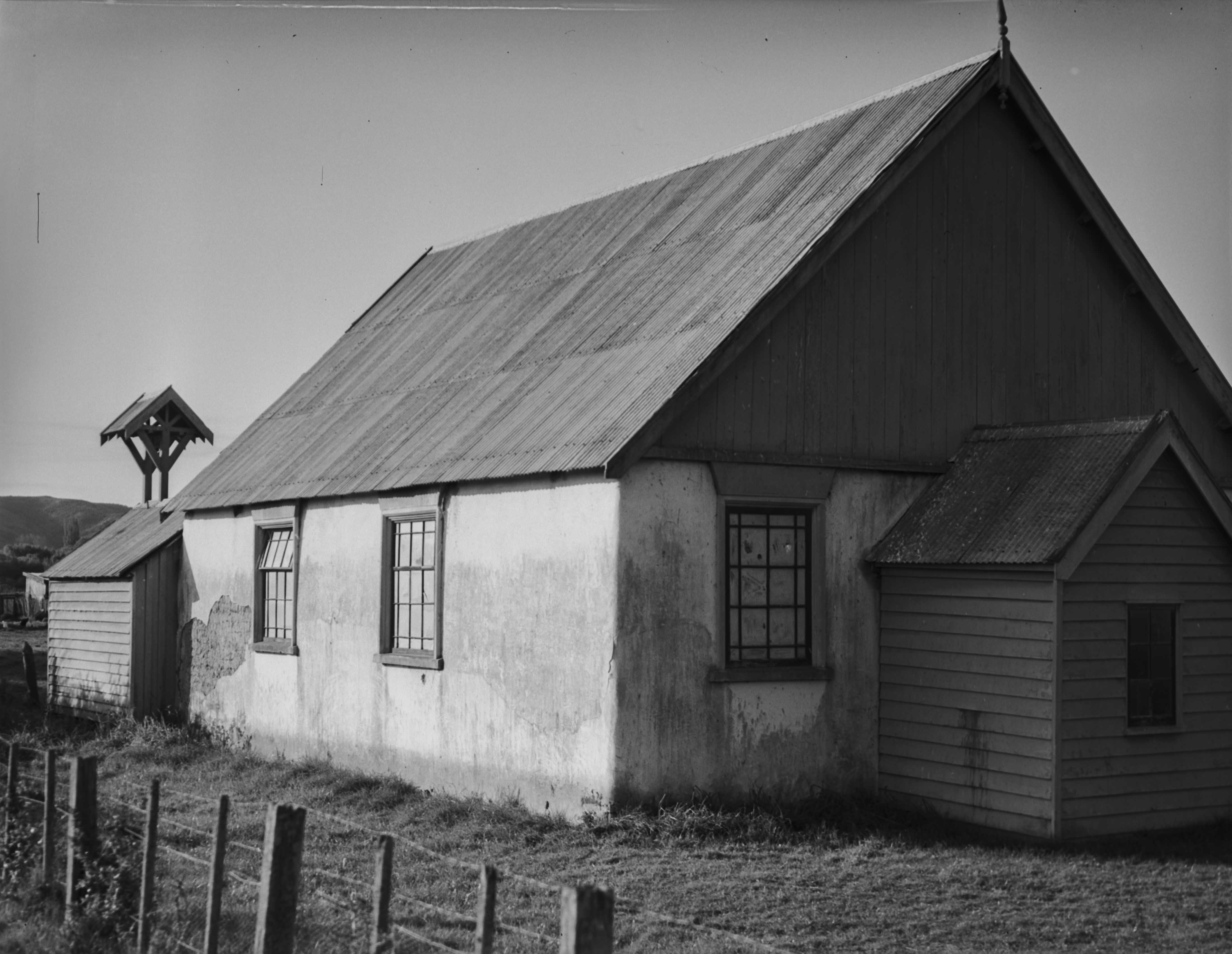
Spring Grove Wesleyan Chapel (1858 – 1958)
In the very early years of settlement in Waimea South, baptisms and marriages were most often conducted in private homes. Wesleyan church services in the district were first held in the Spring Grove Schoolroom, originally opened in 1845 as a Sunday school. This was the same “Moore’s School” wooden building, donated for the cause and notably transported 14 miles from Nelson to Spring Grove by Mr Andrews and his team of 14 goats.
In a letter written in August 1851, the Reverend Samuel Ironside provided a list of preachers and their residences on the Nelson Circuit Plan covering the period from 3 August to 26 October 1851. While William Hammond and John Mears both resided in Waimea South, many other preachers including Rev. Samuel Ironside would alternate Sundays preaching in Nelson and travelling out to the “country Villages of the Waimeas”.2 At this time Spring Grove services were held at 11.00 a.m. and 6.00 p.m. on Sundays, with an additional evening service held at 7.00 p.m. on Tuesdays.
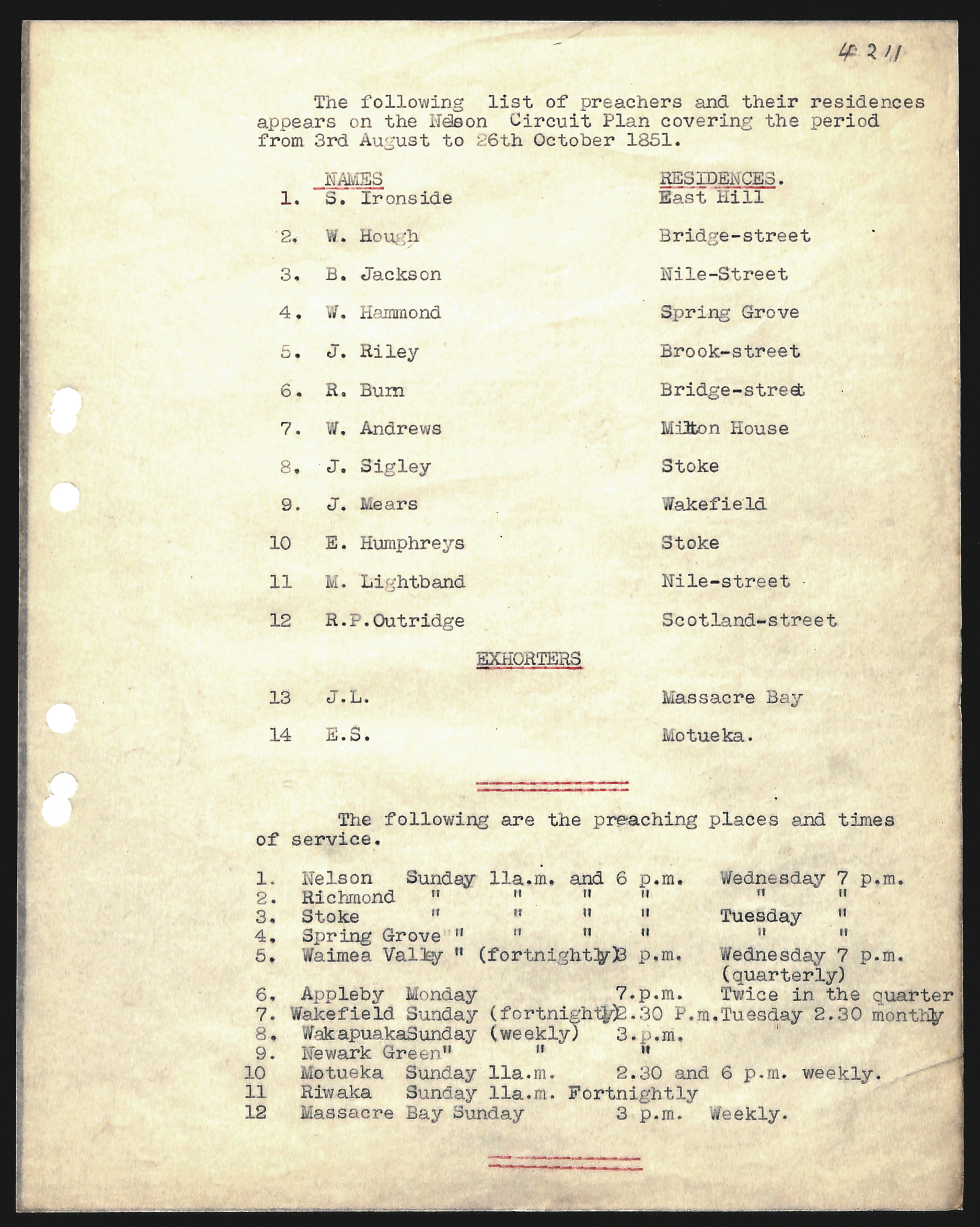
In marginal notes Rev. Ironside wrote on the Circuit plan, he describes the early Spring Grove chapel as:
“Weatherboard Chapel will seat 70. Society 20. Good Sunday school. No Natives. 14 miles from Nelson.”3
Presumably this was still the school room as it was not until 1855 that the trustees of the Baptist church called for tenders to have erected a small wooden building very close to the later site of the Spring Grove railway (now Telenius Road).4 This short-lived chapel was opened on Sunday 30th of December 1855 and both the Baptists and Wesleyans shared this facility for worship.
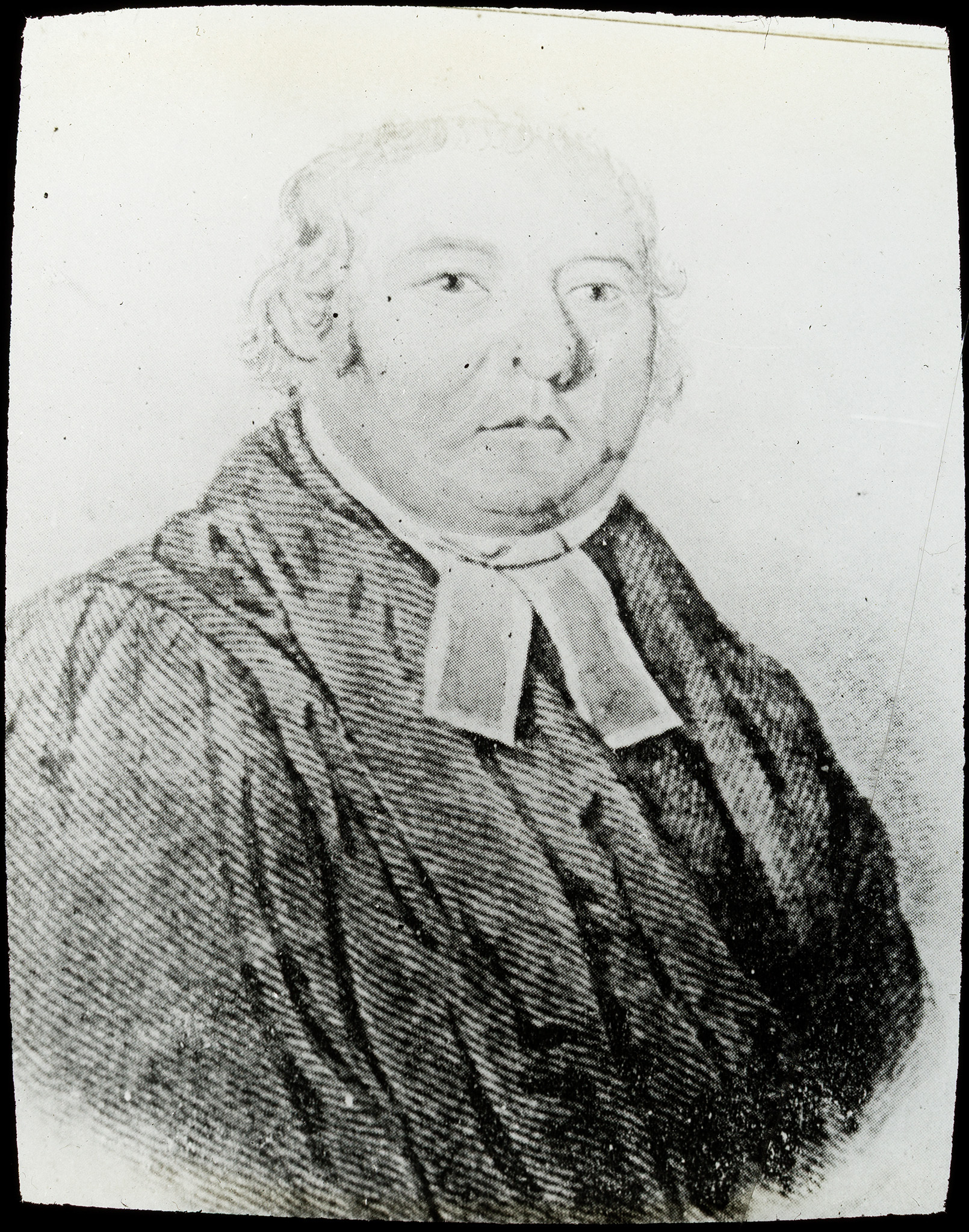
Lantern Slides, Box 10).
Ministers’ Portraits, LF Box h).
Opening and Anniversaries
According to historical notes published in the 1858–1958 centenary service sheet, three acres of land were acquired by the Wesleyan congregation in 1857 for the church site, located approximately opposite Jeffries Road. This land was situated on Section 39, with frontage to the original Main Road to Wakefield and bounded on the northern side by Roughton’s Lane.
The opening date of the cob chapel is somewhat puzzling. In The History of Methodism in New Zealand – The Colonial Churches (1900), Reverend William Morley records the opening as 19 May 1857. This date is repeated in later accounts, including the church land history prepared for the site, which appears to rely on Morley’s work. However, there are no contemporary newspaper reports or advertisements to support an opening on this date.
It is possible that Morley was instead referring to an earlier, temporary wooden structure. He describes a small church building that, in 1855, was relocated to a site opposite the present church section. This would appear to be more likely the building opened in 1857, rather than the cob chapel itself.5
To add to the mystery, in November 1857 during the 12th anniversary of the Sunday School celebration “tea was provided in the school-room at five o’clock pm for the inhabitants of the district and those visitors from Nelson present at this interesting gathering, and the children were regaled in the same way outside on the grass. There were about 80 adults and 70 children present on this occasion, who were clean, neat and cheerful in appearance.
About seven o’clock the friends and some of the children adjourned to the Baptist Chapel, which is a more airy building than the schoolroom, for the purpose of learning what was the aspect of the school affairs, both in regards to teachers and pupils, and of hearing various gentlemen address the assembly. Upwards of a hundred persons old and young, met in the chapel.”6
The Wesleyan’s cob building could seat up to 200 persons, leaving us to ponder why they would need to adjourn to the smaller Baptist chapel.
And in 1937 when the Nelson Evening Mail ran a story on the Chapel’s 80th anniversary celebration the reporter wrote:
“For some time during the early part of the year 1857 there was much activity on the site of the present Spring Grove Methodist church, for the members and adherents were engaged in erecting the present cob-walled building which was opened for worship by the reverend John Warren of Nelson on the 19th of May of that year”.7
However, in April 1858, all three Nelson newspapers ran advertisements for the Public opening event, on Sunday 18th April 1858, followed by a report in the Nelson Examiner and New Zealand Chronicle:
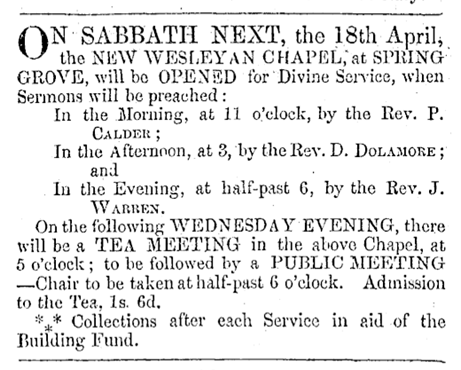
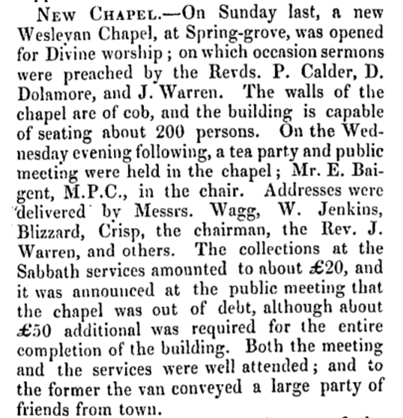
Volume XVII, Issue 33, 1858, Page 2).
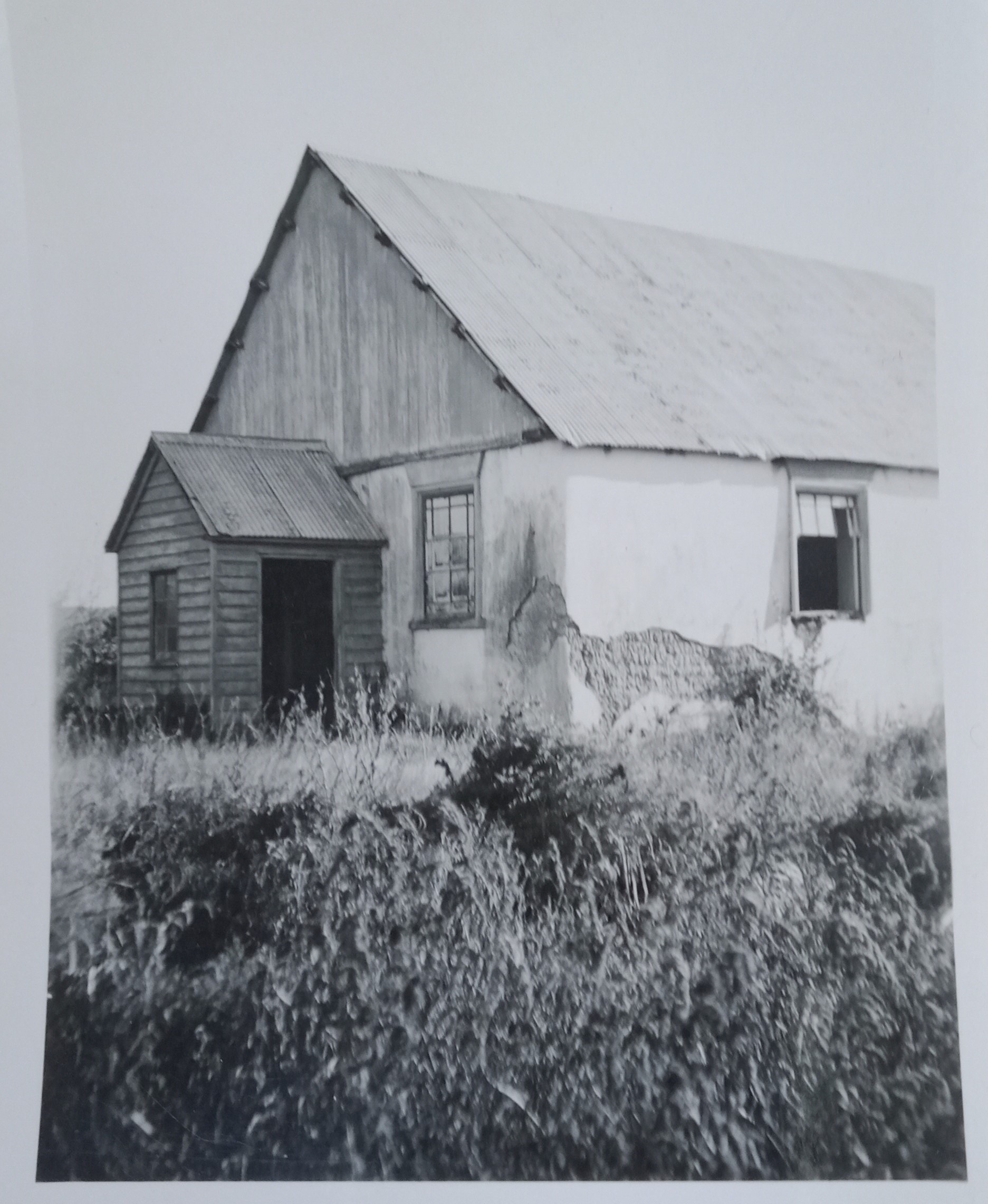
The building, which had cost 250 pounds, had 15-inch (38.1cm) thick walls made of rammed earth and coated with white plaster. A large cellar from whence the clay had been sourced was concealed beneath the building. There were large windows, rows of straight-backed pews and the Church was lit by 6 gas lamps hanging from the ceiling, which were never replaced by electricity. Martha Rutherford, mother of Lord Ernest Rutherford, played the organ.8 Rev. William Morley wrote that all members of the congregation took part in the building of the chapel which was modelled on the ‘English Model Deed’9 ideals. A great many years later on the occasion of the 80th anniversary, 88-year-old former member Mr George W. Andrews told the gathering of his memories of building the church and holding office in it.10
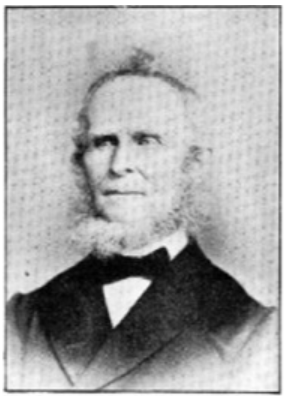
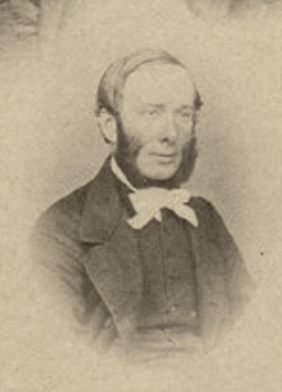
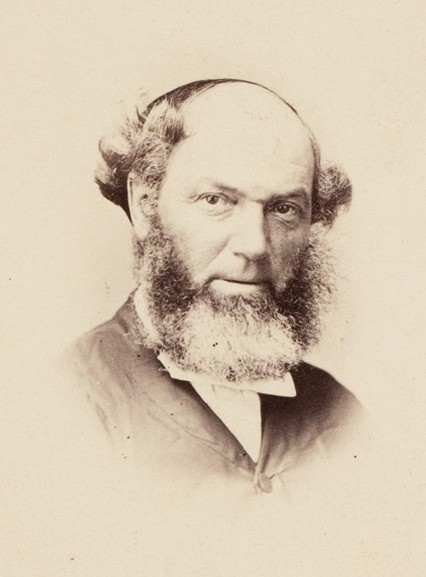
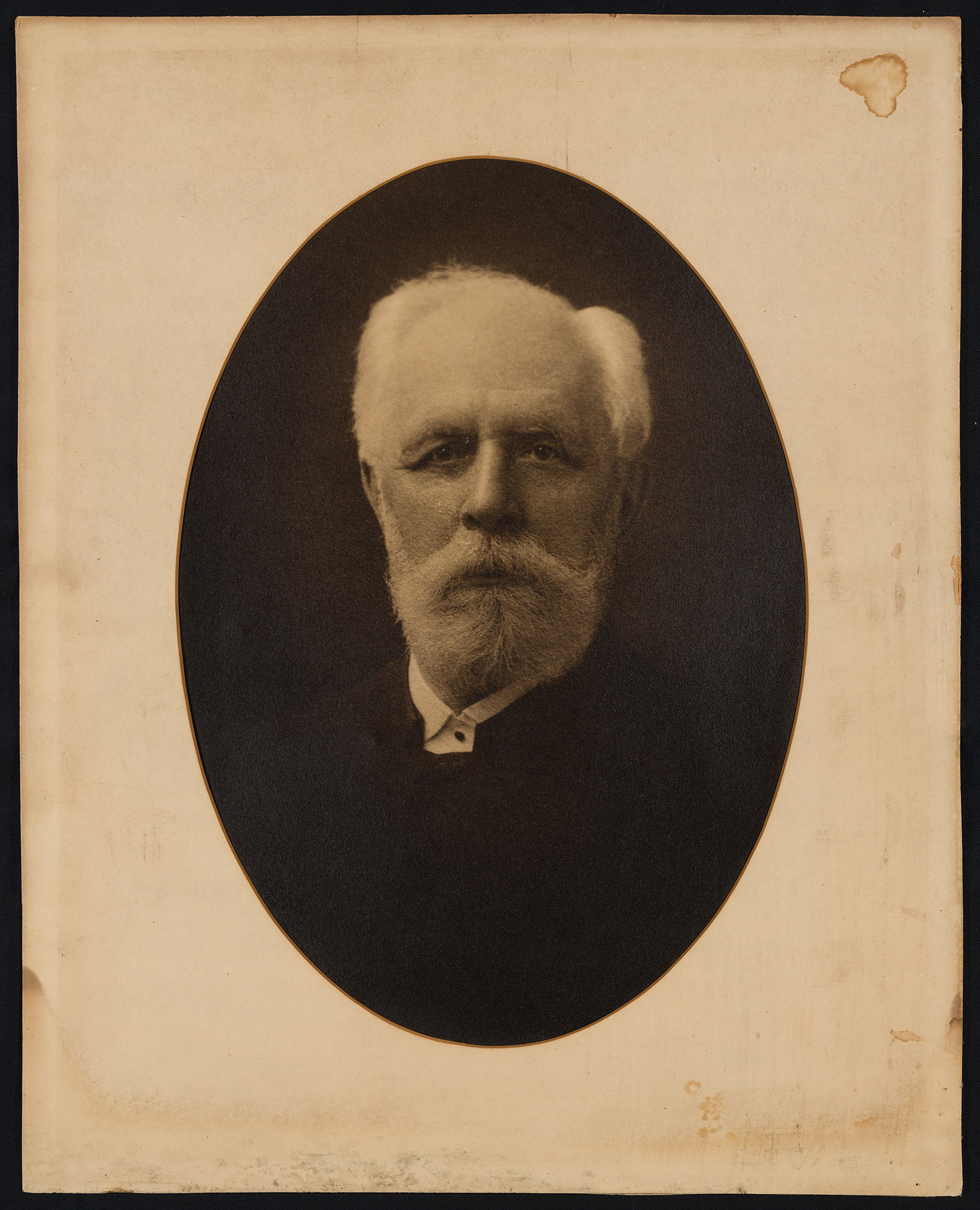
Ministers’ Portraits, Box 16l).
In the early days of this cob church people came from far and wide for services. They walked or drove to the Main Road from the Mt Heslington area, from all around Spring Grove and the village of Brightwater. The Mr and Mrs John Rutherford family (Uncle to Lord Rutherford) drove from the Hope side of the Wairoa river in a buggy with a pair of horses. For quite a period of time the Spring Grove congregation was larger by far than the Richmond church.11
Special, separate Tea meetings were held twice each year to celebrate the Anniversaries of both the Wesleyan chapel and the Wesleyan Sunday school. The Chapel celebration was held every Easter, while the Sunday School celebration was held every November.
In 1863 the Colonist newspaper reported on the Tuesday 2nd June evening service at the chapel, when a tea meeting was held for the purpose:
“...of introducing and endeavoring as far as possible to pay for a very unique and elegant tea equipage, which has been got out from England for the use of tea meetings in connection with the chapel, bearing the inscription "Spring Grove Wesleyan Chapel." A goodly number of friends sat down to tea, after which a most deeply interesting and instructive lecture was delivered by the Rev. W. Cannell.”12
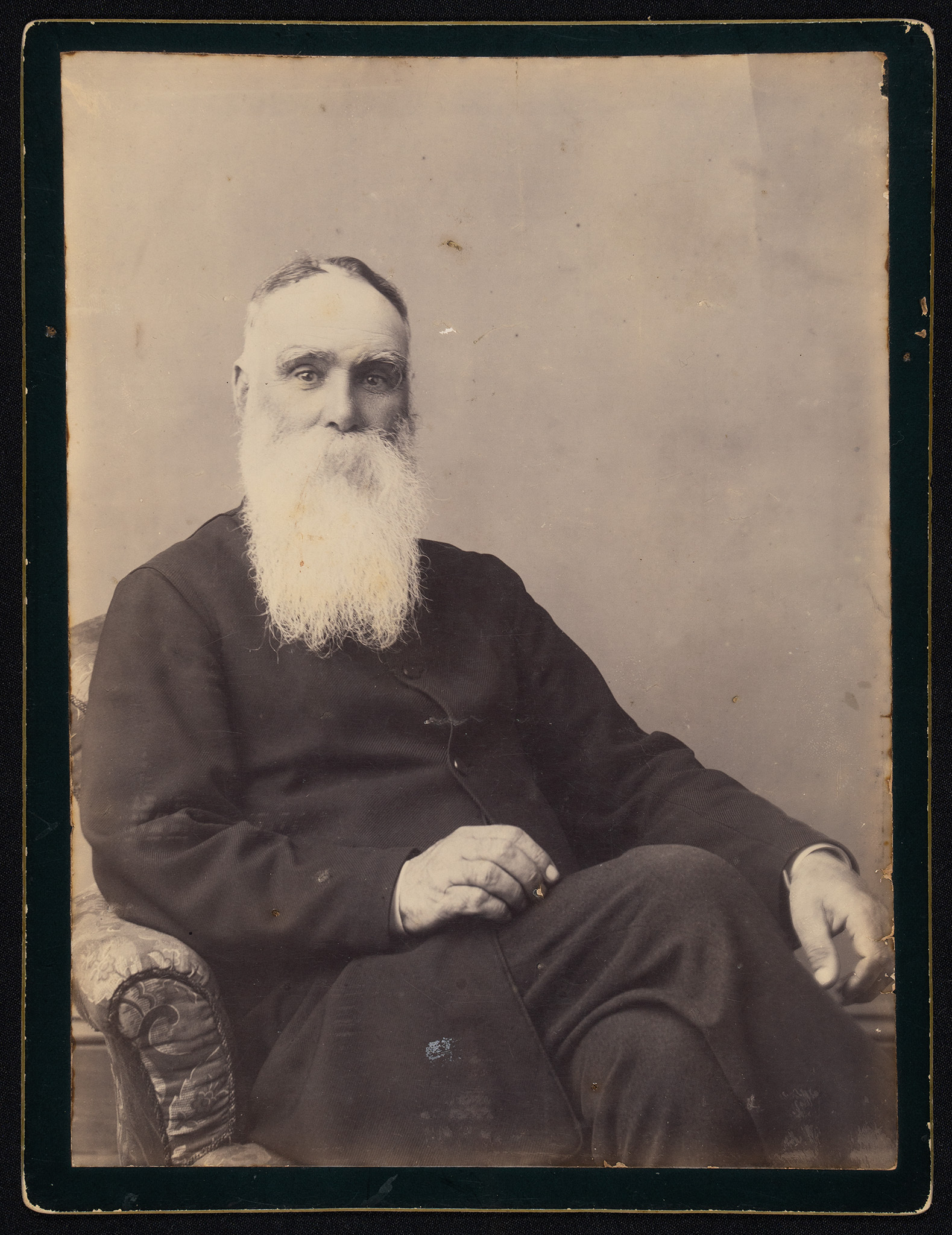
Ministers’ Portraits, Box 3e).
When the anniversary celebration of 1866 was held, on Good Friday, 30th March, there was such a huge turnout, that the Tea had to be served in three sittings:
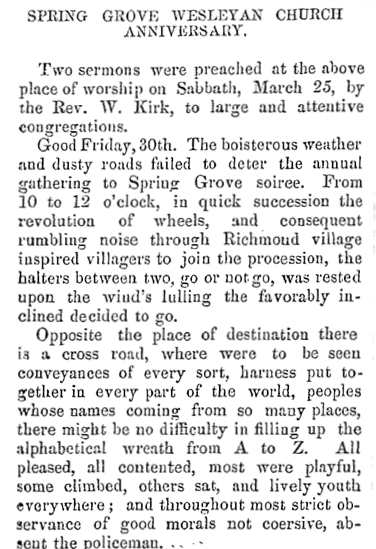
31 March 1866, Page 3).
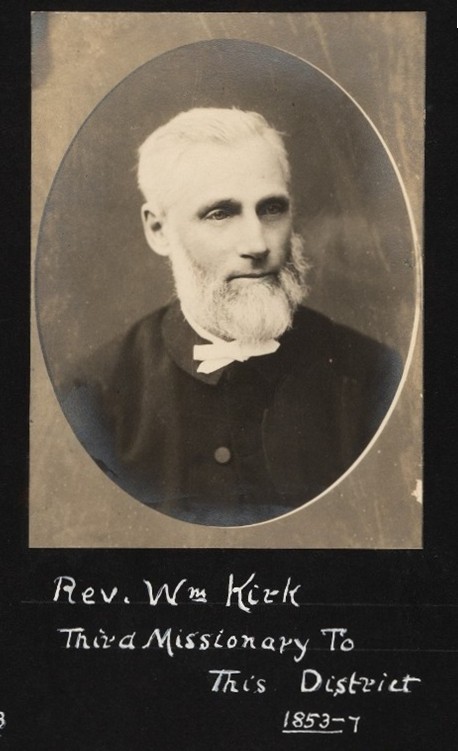
Ministers’ Portraits, Box 9u).
Again in 1867, a large gathering of 300 persons partook in the Anniversary tea, and the Nelson Evening Mail reported that the chapel’s debt had been liquidated throughout the year, while the Trustees had resolved upon raising the roof and erecting a gallery in the building.13
By the time of the 1876 Wesleyan Sunday School anniversary celebration on the 9th November, the railway had reached the district and the newspaper advertisement included for the first time mention of the arrangement of a special train which would convey town visitors home, returning to Nelson about 11pm. Special trains were then laid on in successive years.14
Harvest Festivals and Pumpkin
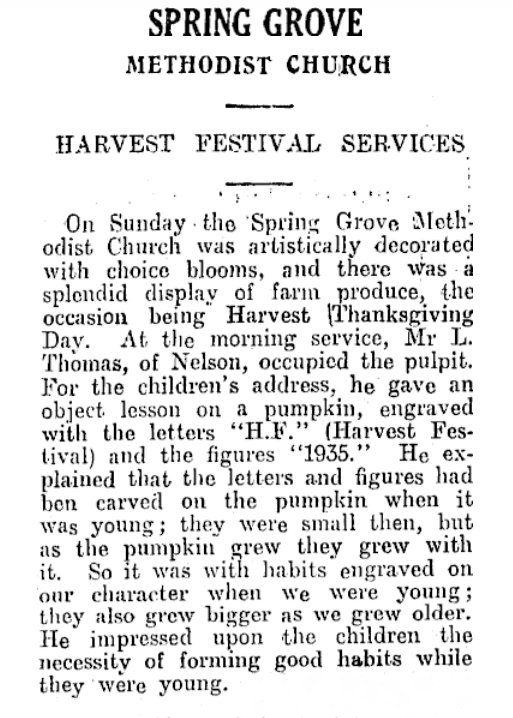
In its Local and General column on the first of April 1916, the Nelson Evening Mail advised readers that “at the Spring Grove Methodist Church to-morrow morning, Harvest Festival will be held, and the Rev. A. Ashcroft will conduct the service. The Thanksgiving will be continued on Monday evening, when the produce, etc., will be sold.”15 The Harvest Festival moved around the churches in the Circuit. Fast forward to 1935, and the paper reports on the Harvest Thanksgiving festival held in Spring Grove again that year, where the preacher presented the children with a special pumpkin as a novel way of discussing character:
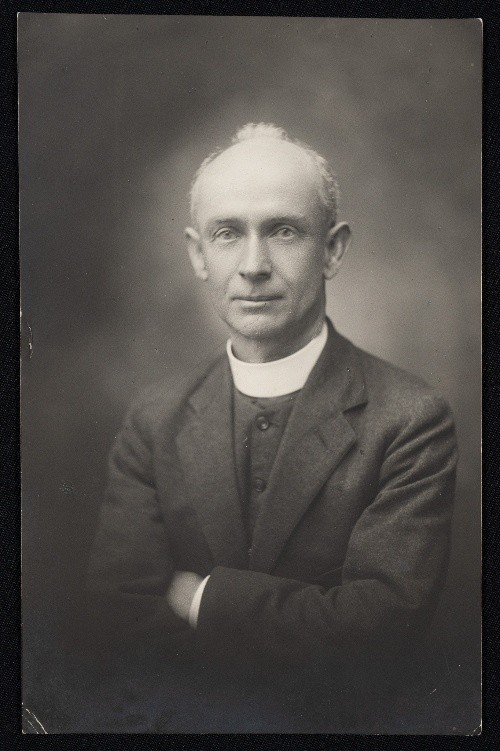
Archives: Ministers’ Portraits, Box 1i).
Circuit Changes and Community Life
Throughout its history, Wesleyan/Methodist organisation in the district underwent several changes. In 1881 Spring Grove was one of eight places, along with Richmond, Upper Wakefield, Stoke, Hope, Foxhill, Brightwater and Dovedale, constituted as the New Richmond Circuit, led by the Reverend Joseph Berry. Originally Spring Grove boasted larger congregations than Richmond.
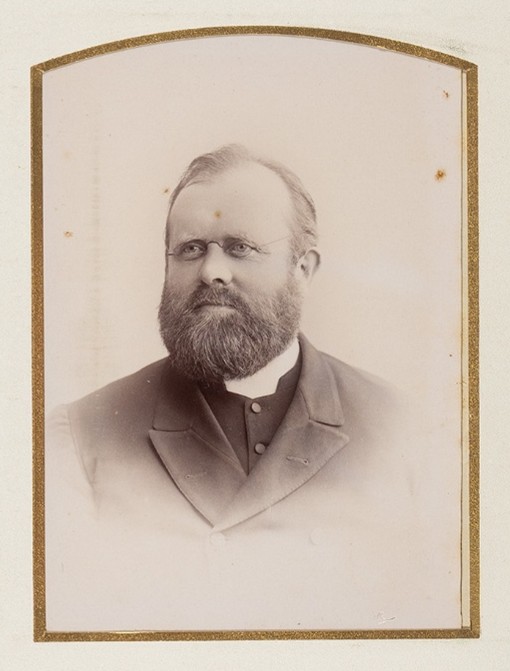
Photograph album, Box 6)
In the mid-1920s the Richmond Circuit extended from Stoke to Dovedale, however at the Circuit’s quarterly meeting, held in Brightwater on April 4, 1928, the Wakefield–Dovedale Home Mission Station was established, which now included Spring Grove, Wakefield, Wai-iti, Foxhill, Tapawera, and Dovedale.
The Wakefield-Dovedale Home Mission Station remained active for 21 years. Its first quarterly meeting was held in Wakefield on July 4, 1928, Reverend P. N. Knight presiding. He was joined by Home Missioner, J. A. Daglish and 14 other members. In July 1929, the new district recorded 83 adult members. But by 1937, congregations in smaller areas like Spring Grove and Wai-iti declined, and activity increasingly centred on Wakefield. Evening services at Spring Grove were discontinued and the Sunday School was reduced to 4 scholars and closed at the end of that year. Appreciation was expressed of the splendid services of the Superintendent, Mr Percy Roughton, in his years of work in the Sunday School at Spring Grove.
The decline continued in the early war years with church work focused mainly on Wakefield and Dovedale, by mid-1940 and reflecting a severe decrease in local preachers, services were rearranged to allow the visiting minister to teach Sunday School in Dovedale on Friday, lead Bible Class there on Saturday evening, conduct Worship at 11am on Sunday before returning to Spring Grove for service at 2.30pm and another in Wakefield at 6.30pm. The buildings at Foxhill and Wai-iti were disposed of due to disrepair and the roll had dropped to 41 members.
The decline continued and services were rearranged to Dovedale 11am, Wakefield 2pm and Spring Grove 3pm on Sunday only.
At Spring Grove on October 22, 1947, the quarterly meeting received the recommendation of the Special Meeting called by the Synod that “the Wakefield-Dovedale Home Mission Station as at present constituted be amalgamated with Richmond Circuit as from April 1, 1948.” Conference approved the move and the final quarterly meeting of the Home Mission Station was held at Wakefield on March 23, 1948, with an attendance of four, bringing this period of local church organisation, and regular services at Spring Grove to a close.16
The Bell and the Lamb: Two Parish Pranks
There was a little belfry at the back of the church, where the church bell was rung by pulling on a rope. One day when the unsuspecting bell ringer went to call the flock for service, the 35kg bell fell to the ground. Imagine the glee of the unnamed mischief makers who had removed some of the nuts and bolts holding it in place!17
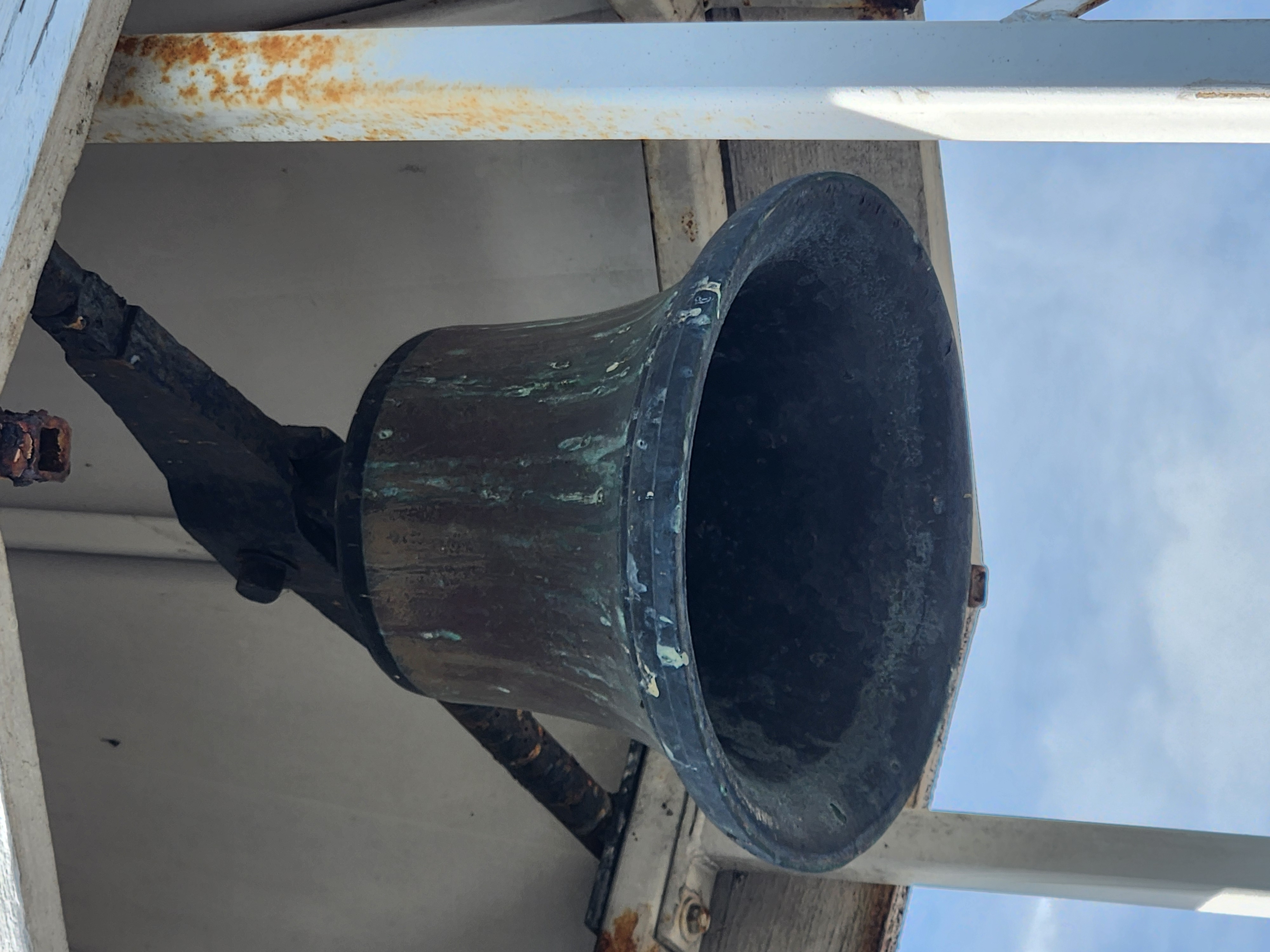
(Photograph courtesy Sarah Arnold).
After the Church was demolished in the late 1950s, the bell was given to the Richmond Methodist church where it was installed in the Bell Tower. In 1976 the Church steeple was removed for repairs and the bell installed in a ground level belfry until 1978 or ’79, when Mr J Walker built a new Bell Tower, sandblasting and repainting the bell before it was installed. From then on it called people to worship Sunday after Sunday, until that church too was demolished in February 1992, however the bell remains at the entrance to the Wesley Garden as a memorial today (2026).18
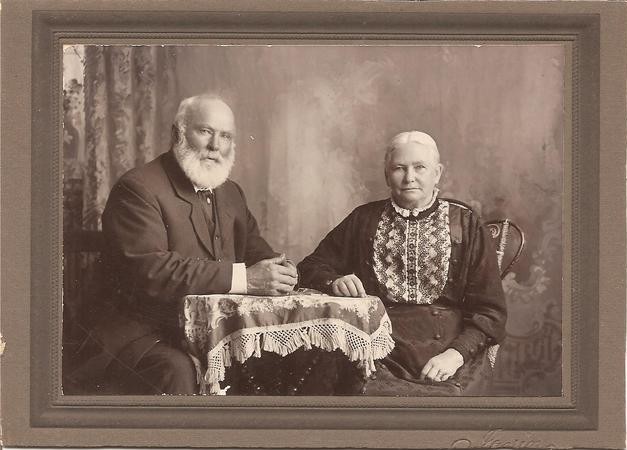
The second story that played out in 1860 had serious consequences for a 15-year-old lad by the name of Joseph Wratt. Joseph’s family were devout founding members, and prominent in the prayers of this church was the phrase “Lamb of God”. One particular service a group of lads had arranged a dead lamb above the door. When church elder Brother Rutherford opened the door, the lamb fell down on his head. Unfortunately, Joseph was just behind the elder who wrongly blamed him for the prank. Brother Rutherford picked up the lamb and hit young Joseph over the head with it. Joseph grabbed the other end of the lamb to prevent being struck again and in the ensuing fray the lamb was pulled in half. His father George Wratt (senior) arrived and was so angry at his son for fighting a church elder he blamed him for the events.
Joe protested his innocence but to no avail, and angry at the injustice he walked off, and kept walking, all the way to his oldest half- brother, another George, in the Lower Wairau. This involved a tramp of several days through a bush track over Spooner’s Range, up the Motupiko River to Tophouse, then a drop down into the Upper Wairau River to trudge down river to his brother’s farm near Grovetown, which was a couple of miles short of the mouth of the river.
Sometime later Joe’s mother wrote to him there, explaining that one of the other boy’s mothers had gone to see his father George senior, telling him it was her son who had put the lamb above the door. However, he never returned nor saw his parents again. His father died not long after this unfortunate misunderstanding.19
Later Years and Legacy
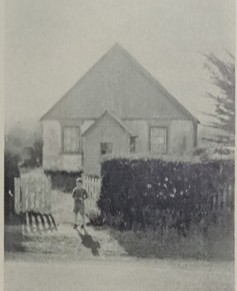
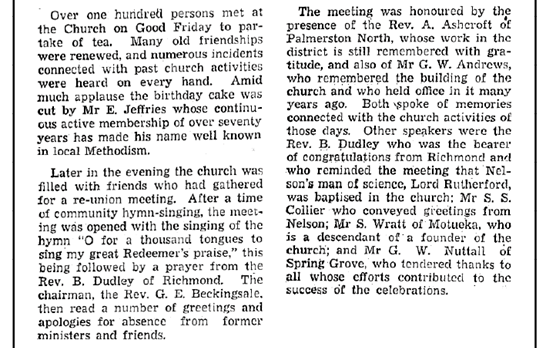
Aside from the annual anniversary services, the Spring Grove Chapel saw two very special anniversary commemorations. The first of these in 1937, was held in the Chapel to celebrate its eightieth anniversary:
The other, held in April 1958 to celebrate the centenary of the Spring Grove Church, was held in the Brightwater Hall as the unused Chapel had fallen into disrepair.
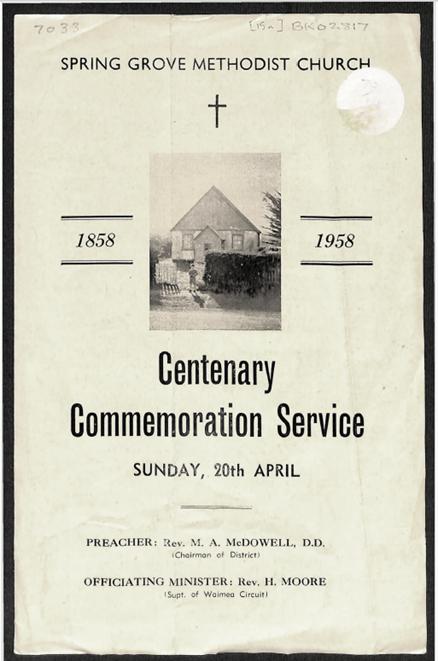
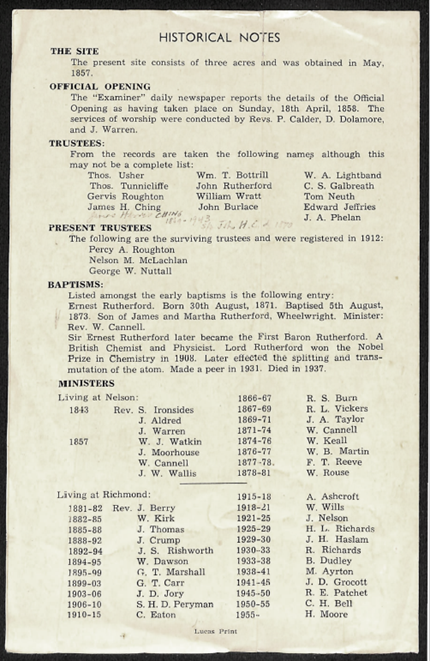
The Centenary Commemoration Service held on Sunday April 20th, 1958, was conducted by the Rev. H. Moore, and the Preacher was the Rev. M.A. McDowell, chairman of the District. The Service was attended by 130 people, reflecting the strong community connections formed over the previous century. The few remaining members were Mr and Mrs Nelson McLauchlan, Miss Ethel Hall, Miss Amy Fowler and Mrs Roy Palmer.
Afternoon tea was provided and served by Guild members of Brightwater and Wakefield.20
Although the old cob church still stood at that time, it had become unsafe and was later demolished. A pilgrimage was made to it during the afternoon by old members. The last service in the Church building itself had been in 1953 with a tiny congregation.21 Although the building held historical significance, including its association as the baptismal church of Lord Rutherford, sadly the Historic Places Trust deemed restoration not feasible. Some crockery from the church was preserved, and the site was managed by the Waimea Parish until negotiations for sale of the land commenced in 1993.22 Marking the loss of a significant piece of Spring Grove’s heritage.
Where is the story located?
The Wesleyan Chapel story is still under development by our team and is not available yet. In the mean time, check out our other stories!
Agumented Reality Experience
Our Augmented Reality (AR) app is currently under development. The app will allow posts to be scanned, bringing the stories into life!
References
- Church Histories (c.1900 – present): 1872-1972 A Record of 100 Years of Wakefield Methodist Church – Methodist Witness in the Township and District of Wakefield. (1972). P.6. (Kei Muri Māpara/Methodist Church of New Zealand Archives Christchurch [Archives reference: MS-39, 15l, 4211]).
- Church Histories (c.1900 – present): 1872-1972 A Record of 100 Years of Wakefield Methodist Church – Methodist Witness in the Township and District of Wakefield. (1972). P.4. (Kei Muri Māpara – MCNZ Archives: MS-39, Box 15, Item No: l).
- S. Ironside to Rev. E. Hoole – 5.8.1851 (Kei Muri Māpara – MCNZ Archives: MS-39, Box 7, Record No. 25, Part No. 4210-4212).
- Nelson Examiner and New Zealand Chronicle, Volume XIV, Issue 3 (11 July 1855). Advertisements Column 1 P.2.
- Morley, W. (1900). The Colonial Churches. In The history of methodism in New Zealand (p. 381). McKee and Co.
- Spring Grove Sunday school anniversary. (1857, November 13). Colonist, Issue 7, p.3.
- Cob-walled Church eightieth anniversary at Spring Grove. (1937, April 3). Nelson Evening Mail, Volume LXXI, p.10.
- Stringer, M. J. (2006). Wesleyan Chapel 1858 – 1958. In More Wakefield spuds: More Waimea south history (p. 54).
- Morley, W. (1900). P.381.
- Nelson Evening Mail, Volume LXXI, 3 April 1937, Page 10.
- Church Histories (c.1900 – present): The Early History of the Methodist Church, Brightwater, Nelson (Waimea Circuit). (1980). P.2. 1851 (Kei Muri Māpara – MCNZ Archives: MS-39, Box 15, Item No: m).
- Colonist, Volume VI, Issue 586, 5 June 1863, Page 3.
- Nelson Evening Mail, Volume II, Issue 92, 22 April 1867, Page 2.
- Nelson Evening Mail, Volume XI, Issue 238, 4 November 1876, Page 2.
- Nelson Evening Mail, 1 April 1916, Page 4.
- Church Histories (c.1900 – present): 1872-1972 A Record of 100 Years of Wakefield Methodist Church – Methodist Witness in the Township and District of Wakefield. (1972). P.13 - 21 (Kei Muri Māpara – MCNZ Archives: MS-39, Box 15, Item No: l).
- Methodist Connexional Property Committee Land Story Collection (1993): Discovering our land story Waimea Methodist Parish (Kei Muri Māpara – MCNZ Archives: Folder No.19, Box 5.)
- Church Histories (c.1900 – present): Waimea Methodist Parish – 170 years of Methodism in Richmond 1843 – 2013. (Kei Muri Māpara – MCNZ Archives: 2013. Box 15, h).
- Arnold (Curnow), E. S. (2009). The (W)Ratt Race: From Rutlandshire, England Through Nottingham to New Zealand. (p.500). The Copy Press.
- Church Histories (c.1900 – present): The Early History of the Methodist Church, Brightwater, Nelson (Waimea Circuit) (1980). P.2. 1851 (Kei Muri Māpara – MCNZ Archives: MS-39, Box 15, Item No: m).
- Stringer, M. J. (2006). More Wakefield spuds: More Waimea south history (p. 54).
- Church Histories ( c.1900 – present): 1872-1972 A Record of 100 Years of Wakefield Methodist Church – Methodist Witness in the Township and District of Wakefield. (1972). P.27.
- Story thumbnail: Clay Church, Spring Grove. (Nelson Provincial Museum, Ellis Dudgeon Collection: 212006).